 (informationweek) -- Pioneer on Monday said it has developed a read-only optical disc with a capacity of 400 GB, far more than any disc commercially available today.
Pioneer said the disc has 16 layers, each capable of storing 25 GB, which is the maximum of a one-sided Blu-ray disc used to store high-definition video. The company said its technology can be used in building recordable discs and can also be read by Blu-ray players after tweaking the hardware.
In building the disc, Pioneer overcame the difficulty of obtaining clear signals from each layer of a multi-layer disc. Crosstalk from adjacent layers and transmission loss have been the biggest problems.
Pioneer said it solved the problems by developing a new optical disc structure that can play back high-quality signals from every layer. The company also developed a "compensator" and a light-receiving element for reading signals when there's a high signal-to-noise ratio in the optical pick-up mechanism, according to Pioneer.
The growing storage needs of business and consumers are expected to drive demand for higher capacity discs. In addition, offering one disc equal to many commercially available discs today will conserve resources, Pioneer said in a statement issued from Japan.
"This development has bolstered Pioneer's confidence in the feasibility of a large-capacity optical disc, which is expected to become necessary in the near future," the company said.
Pioneer plans to release the details of its research at the International Symposium on Optical Memory and Optical Data Storage, which is scheduled for July 13 in Hawaii.

08 July 2008
Pioneer Develops Ultra-High Capacity Optical Disc


Microsoft warns of “active, targeted” ActiveX control attacks
 (osnn.net) -- Microsoft has issued a pre-patch security advisory warning about the Microsoft Office Snapshot Viewer ActiveX control. It contains a vulnerability which can allow a remote unauthenticated attacker to download arbitrary files to arbitrary locations.
Vulnerability Note VU#837785 @ US-CERT
This advisory has information on setting the killbit in order to avoid this attack.
See the Microsoft Security Advisory 955179 for more information.
See also Microsoft Support Document 240797 about how to set the kill bit.
01 July 2008
Nintendo Console Keychain Set
 (coolest-gadgets) -- If you’re a geek who grew up in the late 80’s, you can’t help but hold a special place in your heart for Nintendo. It’s just how it is. Super Mario, Paperboy, Duck Hunt. These are all games we grew up spending hours doting over. While we might have high-tech alternatives these days, such as the PS3 and Xbox 360, sometimes there’s just no alternative for the classic 8-bit system.
As awesome as PS3 might be, you don’t see anyone walking around with PS3 keychains. And you probably shouldn’t plan on it either. NES was a trend setter. It showed us how gaming could bring us together while entertaining us alone as well. Which is why there are so many people which would be honored to display their love of retro gaming, right from their keychain.
This set of Nintendo console keychain charms offers mini versions of the console itself, a game cartridge, and the NES controller. All three of these legendary classics are included on one keyring. It’s a perfect way to show off your old school gaming pride, while spreading the word about the wonders of 8-bit gaming.
The NES keychain set can be yours for only $5.99. We’ve got to admit, that’s quite a bargain for the chance to rock your favorite console of all-time right from your keychain. As geeks, we might not always be chic, but damn are we cool.
Portable Gaming Solutions XBox 360 Portable
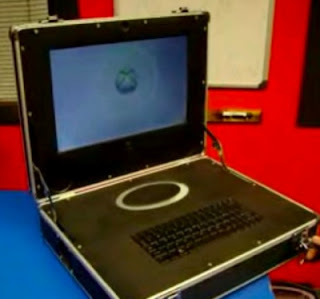
(itechnews) -- We have seen PS3 laptop before. Now the Portable Gaming Solutions website offers the XBox 260 Portable, a laptop size XBox. A XBox 360 is being converted in to a suitcase-sized box. It comes with integrated speakers and a 15-inch monitor.
Watch the video demo after the break:
Take A Look At Sony's Official Bluetooth Headset

(kotaku.com) -- On the PS2, Sony offered a headset with the purchase of SOCOM, help sweeten the deal. Seemed to work well, so no reason to go changing things, is there? So when SOCOM Confrontation is eventually released, it'll be released with this, Sony's official (and, for what it is, quite classy) bluetooth headset. Those with a yearning for the headset - but not for SOCOM's special blend of tactical squad combat - should know it's OK, you'll also be able to buy it separately. The dock's a considerate touch.
Blizzard gives sneak peak of Diablo III
 Dungeons ... a screenshot from Diablo III, unveiled at game developer
Blizzard's Worldwide International event in Paris / IGN
(news.com.au) -- THE third instalment of the popular Diablo game series has been announced by video game development studio Blizzard Entertainment.
11,000 passionate fans watched the first demonstration of Diablo III at Blizzard's two day Worldwide Invitational event in Paris.
The studio, part of Vivendi Games, is well known for its game World of Warcraft, which now has over 10 million subscribers to its online world. Blizzard is also behind Starcraft – one of the most popular videogames for competitive play, even ten years after its original release.
Diablo III comes almost eight years after Diablo II was released in 2000. The new role-playing game (RPG) will see players cut a swathe of bloody destruction across a dark fantasy world teeming with evil.
Whether playing alone or with friends, the game promises plenty of replay value thanks to a heavy emphasis on randomly generated content, and a choice of five distinct character archetypes.
It also benefits from a heavily stylised visual design, giving its world a rich, painted aesthetic - the perfect backdrop to visceral, intense action.
The Worldwide Invitational, however, was about much more than just Diablo III.
The event was a chance for fans to get exclusive inside access to upcoming Blizzard games and to hear from members of the studio.
The hugely anticipated titles Starcraft II and World of Warcraft: Wrath of the Lich King were both available to play for members of the public, with around 500 PCs set up in the venue.
A number of panels discussed aspects of Blizzard's upcoming games in detail, giving members of the public an inside look at the process of making games, as well as a chance to ask questions.
The event also hosted several fiercely contested competitive tournaments. Teams from around the world flew in to compete for $100,000 in prizes across Starcraft, World of Warcraft and Warcraft III.
The tournaments were slick, professional and incredibly popular. They bore more than a passing resemblance to more traditional sporting contest - players competed in front of thousands of passionate fans while commentators followed the action and every detail was shown on massive screens.
In parts of Asia – South Korea in particular – "e-sports" are firmly entrenched as popular entertainment, while they are steadily gaining popularity in the West.
Starcraft is often dubbed the "national sport of South Korea", with tournaments regularly broadcast on television and the best pro players treated as legitimate sports stars.
Blizzard is one of many companies betting that competitive gaming will gain a similar status worldwide. It will probably continue to be a slow process, as the action can be nigh on incomprehensible for those not familiar with the games, but as the number of players continue to rise, the level of interest in watching the best of the best will too.
Regardless, events like the Worldwide Invitational play an important role in promoting the broader acceptance of video games as a powerful form of entertainment.
The sheer scale, excitement and passion of the fans was infectious, and sent a clear message: that video games are here to stay.

Blizzard calls for Microsoft to promote PC gaming
 (gamesindustry.biz) -- Blizzard's chief operating officer Paul Sams has joined in calls for Microsoft to "put more emphasis on the Windows operating system" as a gaming platform.
Speaking to Gamasutra, Sams described how he felt Microsoft was focusing on the Xbox 360 as its primary gaming system to the neglect of the PC.
"Their gaming focus is very much on the [Xbox] 360. And that makes sense, cause they're a hardware manufacturer as well as a software developer. And so they've got a lot of money and investment tied up in that system," explained Sams.
"And I kind of look at it and say to myself that it would be great if they put more emphasis on the Windows operating system, certainly probably the most prominent operating system in the world. Even more so than console boxes."
"And they own and operate that system, so having them put more energy and effort against it - and they would say that they are, but I think that there's more that can be done," Sams added.
Meanwhile Microsoft's Peter Zetterberg, the business development manager for MGS Europe, told GamesIndustry.biz that the company would contine to support different release dates for Xbox 360 and PC titles as the PC versions would take away a significant portion of console sales.
New Cooking Mama title announced for Wii
 (palgn.com.au) -- Publisher Majesco has announced that another addition to the Wii and Nintendo DS cooking game franchise Cooking Mama is currently in the works. While many gamers may be skeptical about the title, Cooking Mama: World Kitchen will be bringing something new to the kitchen with the announcement that the game will ditch the 2D graphics of previous titles, with the series moving into a full 3D graphical title. Fans of the series should rest assured, that while the 2D graphics are being ditched, the game's charming cartoon style look will remain - as you can see for yourself in the media panel.
Along with the graphical upgrade, World Kitchen will serve up a few new dishes, with new mini-games and gameplay mechanics also making their way into the title. Exactly what this means for gamers is unknown at the moment and we'll just have to wait until Majesco feeds us some more information on the subject.
Cooking Mama: World Kitchen is currently scheduled for release towards the end of 2008.


Pentagon will buy satellites to do more spying
 WASHINGTON (AP/yahoo) -- The Pentagon will buy and operate one or two commercial imagery satellites and plans to design and build another with more sophisticated spying capabilities, according to government and private industry officials.
The satellites could spy on enemy troop movements, spot construction at suspected nuclear sites and alert commanders to new militant training camps.
The Broad Area Surveillance Intelligence Capability (BASIC) satellite system will cost between $2 billion and $4 billion. It would add to the secret constellation of satellites that now circle the Earth, producing still images that are pieced together into one large mosaic.
A single satellite can visit one spot on Earth twice every day. BASIC's additional satellites will allow the photos to be updated more often, alerting U.S. government users to potential trouble, humanitarian crises or natural disasters like floods.
The announcement of the BASIC program, expected this week, has been delayed for months, with Pentagon, Air Force, and National Reconnaissance Office officials fighting over who should be in charge of buying, building and operating the satellites. They have also debated whose needs the system will cater to: senior military commanders or policymakers in Washington, D.C.
At stake was not just money but power: billion-dollar budgets are up for grabs, and the agencies' traditional missions and way of doing business have been hanging in the balance.
The National Reconnaissance Office ultimately won the right to buy and operate the satellites, besting the Air Force. And military commanders' needs trumped the White House. They will, for the first time, have the power to dictate what satellites will photograph when they pass overhead. The concept is known as "assured tasking."
"The battlefield today is so dynamic the warfighter needs to be able to respond at a moment's notice. Knowing they have the opportunity to have assured tasking in the next pass of satellite becomes very critical and helpful in the planning of their operations," Josh Hartman, the Pentagon director for space and intelligence capability acquisition, told The Associated Press.
Military commanders have long desired that kind of tasking control. Now, they submit their requests to a national intelligence authority which prioritizes the missions. And sometimes those requests are delayed or rejected.
The new satellite system is meant to bridge what intelligence agencies fear will become a huge gap caused by cancellation in September 2005 of a major component of the Future Imagery Architecture system overseen by the National Reconnaissance Office. Boeing, the primary contractor, ran into technical problems developing the satellite and spent nearly $10 billion, blowing its budget by $3 billion to $5 billion before the Pentagon pulled the plug, according to industry experts and government reports.
The Pentagon now hopes BASIC will fill in some of the lost capabilities.
_First, it will increase the amount of imagery the National Geospatial Intelligence Agency buys from commercial satellite companies GeoEye and DigitalGlobe, which are expected to put four new satellites into orbit by 2013. The U.S. military now has a $1 billion contract with two commercial satellite companies to buy space imagery. A U.S. commercial satellite launched in September by DigitalGlobe can make out the outline of 20-inch object from space. This year, GeoEye is launching a satellite with the ability to see the outlines of a 16-inch object. By 2011, that capability is expected to sharpen to nearly 10 inches. Secret government imagery satellites are believed by experts to have better than six-inch resolution.
_Second, the National Reconnaissance Office will buy, launch and operate one or two commercial imagery satellites with 16-inch resolution, probably around 2014.
_Third, NRO will design and build another more advanced satellite to be launched in 2018. The capability of that satellite, known as Block II, will be defined later.
Underpinning this will be the creation of a new ground intelligence station that will not only download the imagery directly from the satellites and make it available to all users, but will also — in theory — allow the users to tap into the national intelligence database that holds imagery produced by all spy equipment and sources such as satellites, aircraft and ground sensors.
The Pentagon's plan to both buy commercial satellite imagery and operate similar satellites of its own is an attempt to balance two competing goals. National space policy requires the Pentagon to buy as much commercial imagery as possible to help the companies withstand competition from subsidized foreign satellite companies. At the same time the Pentagon does not want to give the companies so much business that they tailor their services to government needs and ignore the private sector they need to make them self-supporting.
The Pentagon satellites will also be a back-up capability in case future commercial satellites malfunction.
The nation's classified network of satellites represents some of the most expensive government programs and receives almost no public oversight. Because of their multibillion-dollar price tags, sensitive missions and lengthy development schedules, spy agencies go to great pains to keep details from becoming public.
But if history is an indicator, the price tag could climb much higher as the new satellite is built. The House and Senate intelligence committees have criticized the Pentagon and intelligence agencies' management of space programs. Half the programs have experienced cost growth of 50 percent or more.
The Defense Department spends about $20 billion annually on space programs.
Earth's Cries Recorded in Space
 (space.com/yahoo) -- Earth emits an ear-piercing series of chirps and whistles that could be heard by any aliens who might be listening, astronomers have discovered.
The sound is awful, a new recording from space reveals.
Scientists have known about the radiation since the 1970s. It is created high above the planet, where charged particles from the solar wind collide with Earth's magnetic field. It is related to the phenomenon that generates the colorful aurora, or Northern Lights.
The radio waves are blocked by the ionosphere, a charged layer atop our atmosphere, so they do not reach Earth. That's good, because the out-of-this-world radio waves are 10,000 times stronger than even the strongest military signal, the researchers said, and they would overwhelm all radio stations on the planet.
Theorists had long figured the radio waves, which were not well studied, oozed into space in an ever-widening cone, like light from a torch.
But new data from the European Space Agency's Cluster mission, a group of four high-flying satellites, reveals the bursts of radio waves head off to the cosmos in beam-like fashion, instead.
This means they're more detectable to anyone who might be listening.
The Auroral Kilometric Radiation (AKR), as it is called, is beamed out in a narrow plane, as if someone had put a mask over a torch and left a slit for the radiation to escape.
This flat beam could be detected by aliens who've figured this process out, the researchers say. The knowledge could also be used by Earth's astronomers to detect planets around other stars, if they can build a new radio telescope big enough for the search. They could also learn more about Jupiter and Saturn by studying AKR, which should emit from the auroral activity on those worlds, too.
"Whenever you have aurora, you get AKR," said Robert Mutel, a University of Iowa researcher involved in the work.
The AKR bursts -- Mutel and colleagues studied 12,000 of them -- originate in spots the size of a large city a few thousand miles above Earth and above the region where the Northern Lights form.
"We can now determine exactly where the emission is coming from," Mutel said.
Our planet is also known to hum, a mysterious low-frequency sound thought to be caused by the churning ocean or the roiling atmosphere.
Black Holes in LHC Small Enough to Be Ignored
 September will most likely see the LHC operational. Credits: CERN
(softpedia) -- The Large Hadron Collider is rapidly approaching completion and should become operational by the end of the year. It will become the biggest particle collider ever built, probably powerful enough to create even microscopic black holes. It has been suggested on a number of occasions, despite CERN’s reassurance, that such a microscopic black hole would come to accrete matter and grow so big that it would eventually destroy the Earth and even the entire solar system.
As far as I can remember, there have been more than one lawsuits against CERN to stop the Large Hadron Collider from ever becoming operational, for fear that a black hole originating inside it would eat the Earth altogether.
Steve Giddings, professor of physics at the University of California, believes that such a scenario is practically impossible. The strongest argument is that microscopic black holes created inside the LHC would be able to exist for only a very small amount of time, roughly a nano-nano-nanosecond, which is too little time for it to accrete any matter at all. And even if these microscopic black holes do not evaporate in this time, the large scale effects they would produce would be basically unobservable.
In a study co-authored with Michelangelo Mangano of the European Center for Nuclear Research, Giggings found that if the LHC were able to produce microscopic black holes then so could cosmic rays coming from space, which are probably more powerful than any particle collider that will be built on Earth. Since no large scale effects or any microscopic black holes have been ever observed in the Earth's atmosphere, it is only logical to believe that they pose no danger whether or not they exist.
"The future health of our planet and the safety of its people are of paramount concern to us all. There were already very strong physics arguments that there is no risk from hypothetical micro black holes, and we've provided additional arguments ruling out risk even under very bizarre hypotheses," Giddings said.
When completed, the system will collide hadrons, composite sub-atomic particles formed of quarks, in order to study the nature of the universe, look for extra dimensions of space and new sub-atomic particles and forces yet undiscovered.
Kaspersky adds anti-keylogger keyboard
 (techworld) -- The new version of Kaspersky’s security suite, Internet Security 2009, features a novel but simple defence against keylogging malware – a virtual keyboard.
Full details have yet to be confirmed, but it is understood that the program will let users bring up the keyboard from which to enter login details for websites such as online banks that might be vulnerable. The on-screen keyboard will cache the keystrokes, protecting them from recording programs that would pick up physical keystrokes coming via the keyboard driver.
It’s not a new idea but Kaspersky is the first major security vendor to include such a feature in a standard Net security program.
The company has also announced a raft of other enhancements to Internet Security 2009, and Anti-Virus 2009, both due out this month.
For the first time, Internet Security will feature applications whitelisting, which will analyse programs against a database from security vendor Bit9 - users will be told about apps that don’t show up with a digital ‘fingerprint’ in this database. There will also the ability to enforce restrictions on external devices such as USB drives, and a security analysis tool will tell users which third-party software needs patching, in a similar mould to Secunia’s Software Inspector.
The company claims it has overhauled the Anti-Virus program to better detect and deal with malware, especially rootkits, found on the system at the point it is installed, as well as adding improved self-protection against malware that tries to subvert Kaspersky itself.
If all this sounds as if it might cause performance to deteriorate, the company has an answer to that too. The new ‘iSwift’ checksumming feature – something that was popular in anti-virus programs as long ago as the early 1990s – will reduce scan loads by analysing only files that have changed since that last scan was performed.
“Our 2009 technology provides […] an unobtrusive security solution that will not slow down their gaming, email, instant messaging, downloading, home working or social networking and other activities. The Virtual Keyboard will further protect those using online banking, to ensure that their money and account details remain safe,” said Kaspersky’s David Emm.
Internet Security 2009 UK Edition, single user, costs £39.99 per annum (£27.99 renewal), with Kaspersky Anti-Virus 2009 UK Edition, single user at £29.99 per annum (£20.99 renewal), available for download from this month.
Firefox 3.1 expected this month
 (pcpro.co.uk) -- Just one week has passed since the final release of Firefox 3.0 and Mozilla has suggested that version 3.1 may be open for download as early as this month.
The news emerged at a Mozilla meeting this week when a draft schedule for Firefox development was discussed.
The release would be a first developer preview, with a beta following in August and a full release scheduled in early 2009.
This schedule has yet to be approved, but Mike Schroepfer, Mozilla's vice
president of engineering, has previously said that he hopes to ship the software even sooner, by the end of 2008.
The short delay between updates is partly due to the fact that many of the features expected in the upcoming release are already "nearly complete", according to Schroepfer. They represent code that narrowly missed inclusion in version 3.0.
Expected in the new software are improvements to the bookmarking functions and an update to the awesome bar, as well as several improvements to the rendering engine courtesy of Gecko 1.9.1, which is under parallel development.
Mozilla claims that over 8 million people downloaded Firefox 3.0 on the day of its release. This is expected to become a world record for the number of downloads on a release day, although officials from Guinness have yet to verify the figure.