 (pcworld) -- Two Orange County, California, teenagers have been charged with breaking into high school offices and using stolen usernames and passwords to change lackluster grades to A's.
Omar Khan and Tanvir Singh, both 18, are facing multiple felony charges following a series of break-ins at Tesoro High School in Rancho Santa Margarita, California. Khan was arrested Monday, and Singh was expected to turn himself into court on Tuesday for arraignment.
According to prosecutors, Khan changed the D's and C's he was receiving in Spanish, Calculus and English to two A's and a B+. He's also charged with stealing tests before they had been given and using a stolen username and password to break into school computers and change the grades of 12 other students.
He is also alleged to have installed spyware software on the computer hosting the school district's grades database so that he could remotely access this system.
The police were called in after Khan requested a copy of his transcript and school officials noticed his stellar grades, the Orange County district attorney's office said.
If convicted, Khan could be sentenced to more than 38 years in prison.
Singh, who faces fewer charges, faces three years in prison. He's charged with breaking into the school with Khan in order to steal an English test on May 19. According to court filings he sent a text message to Khan around 4 p.m. planning the crime. "Hey wana go to the school tonight," he wrote. "I need someone with balls there with me."

21 June 2008
Teens Charged With Loading Spyware, Changing Grades


Hong Kong is Beating Spam, Registrar Says
 (pcworld) -- The Hong Kong Domain Name Registration Company (HKDNR) announced late last week that the daily average number of .hk domain name spam and phishing cases drops 92 percent year-on-year.
According to the "'.hk' Domain Name Spamvertising & Phishing Report" compiled the HKDNR, a daily average of 38 such cases was recorded throughout 2007, while the number dropped to 3 from January to May 2008.
The announcement contradicts -- and may be in response to -- a recent assertion by security vendor McAfee that the ".hk" domain name is the most dangerous, with about 19 percent of its sites serving up malware.
Registrar's Efforts
"HKDNR is committed to providing a safe Internet environment for the community and has put in place various measures against suspicious websites," said Jonathan Shea, CEO of HKDNR. "We have been working closely with the Office of the Telecommunications Authority Hong Kong Police and Hong Kong Computer Emergency Response Team Coordination Centre (HKCERT) to monitor and control the situation,".
"We actively review our systems and domain name registration procedures and policies. In particular, we have implemented more stringent documentary requirements to combat suspicious applications in order to keep pace with the fast-changing Internet world," he added.
Shea noted that the HKDNR has also adopted additional verification measures for online payment of domain registration. He added that The Hong Kong Police inform HKDNR of criminal cases involving '.hk' domains in a timely manner and the HKCERT help HKDNR develop guidelines for verification of phishing domains while OFTA provided an updated list of spamvertising '.hk' domains to HKDNR daily and advised on spamvertising verification criteria.
As a result of these initiatives, more than 14,000 '.hk' domain names were suspended by HKDNR this year by the end of May, he said. Around 85 percent of these were related to spamvertising activities and about 15 percent were related to phishing websites, he added.
Cyber scamsters run for cover
 AHMEDABAD (timesofindia.indiatimes) -- Cyber hackers are ducking for cover after the nation-wide police crackdown following the busting of the online shopping fraud by the Ahmedabad police.
After the arrest of their kingpins in Mumbai, Chennai and Ahmedabad, there are warnings posted on hacking websites against "indulging in 'carding' for the time being".
"Carding in hackers' jargon stands for dealing in a huge database containing confidential information of credit card holders such as user name, expiry date, credit value verification (CVV) numbers and address. Such data are kept by the IT division of any financial institute. Most of the times, hackers enter into protected servers and steal the data. They do it with utmost care and expertise. At any given time, there are more than 5,000 database available on various websites. However, to access it, one has to become member of the paid community," said Sunny Vaghela, a cyber security expert. These hacking websites had many members posting links to TOI's published stories on the online shopping fraud and discussed the implications of opening up of their network.
One post read: "Hope they will come out soon", about the hackers caught. Another read: "Oh s*@#! If they got cards from here then maybe we should close registrations quicker...damn that's lame...old members." In another community, a seeming veteran advised juniors "not to leave cyber footprints and clear up the record before logging out".
The same website forum has tutorials on how to hack into government and non-government organizations and to access backdoor password of financial gateways. After the surfacing of eBay hacking incidents, the website says, cyber crime cells are active in various affected countries and are keeping a tab on suspicious websites.
Lazy Hacker Trick: Tricking Script Kiddies
 (internetnews) -- Security software and consulting vendor Panda is tracking the latest Constructor/Wormer worm threat, and its approach by malware networks to entice script kiddies to their bidding.
The bad guys in this case are cyber criminals, who target databases and banks.
Unleashing applications that make it easy to create malware isn't quite new, but their approaches this time are, according to Panda, which is in the business of providing software and technology security consulting services.
Constructor/Worm's main function is to turn an executable file into a worm. The application is easy to use -- by checking different flags, users can design a worm with different functionalities, according to Ryan Sherstobitoff, chief corporate evangelist for Panda Security USA, which created PandaLabs.
Not only that, it allows them to compress the application with UPX, a free, portable, extensible, high-performance executable packer which is distributed under the terms of the GNU General Public License, or with MuteX, another tool. Compressing malware makes it harder for lab engineers to reverse-engineer.
Advanced options include selecting an infection date, disabling different features in Windows such as the Task Manager, the Windows Registry Editor or the Folder options.
Sherstobitoff thinks the malware was released on the Internet as part of a two-pronged attack by criminals.
"We've seen many of these tools, and the idea is for script kiddies to create malware that will be a distraction while some of the more insidious banker Trojans are committing mass identity theft," he said.
Apparently, cyber criminals hope that wannabe hackers, also known as script kiddies, will be enchanted enough by the ease with which the tool lets them create malware that they'll flood the Internet with new forms of it.
One of the most notorious cyber criminal networks is the Russian Business Network, thought to have been led by the nephew of a well-connected Russian politician.
At its height, it was suspected to have been behind up to 50 percent of the phishing incidents worldwide.
Phishing is an an e-mail attack claiming to be a consumers' bank, asking for details of their accounts.
After its brazen exploits attracted the attention of security experts worldwide, the Russian Business Network went underground for a while. It's now believed to have resurfaced in China.
A similar group in Britain, using the ShadowCrew Website, has been arrested and its leader, Bryn Wellman, was sentenced to 10 years in jail earlier this year.
And according to a survey of 1,000 PC users in March conducted by antivirus software vendor AVG Technologies, formerly known as Grisoft, U.S. citizens are more afraid of being the victims of cyber crime than they are of burglary or assault.
The problem is so bad that more than 200 people from government agencies and private companies in Europe, the U.S., Africa and South America attended a Council of Europe cyber crime forum in Strasbourg in April to develop guidelines for closer international cooperation between law enforcement and Internet service providers
Storm variant targets Olympics fans
 (vnunet) -- Security organisations have warned of a new virus attack that uses the upcoming Beijing Olympics to spread a new variant of the Storm malware.
The vector of attack is an email purporting to contain the news that the Olympics will be delayed or cancelled due to earthquake damage.
Emails contain a link that claims to be a video to back up the information, but the file downloads an application named beijing.exe containing the Trojan.
"Some advice for the day: do not click on every link in your email," said Symantec researcher Vikram Thakur in a blog posting.
"It looks like the Peacomm [Storm] authors have decided to use past and future events in China as lures for their latest creation.
"A new spam run is in progress with links to a file called beijing.exe, which is currently detected by Symantec as Trojan.Peacomm.D."
The US Computer Emergency Readiness Team has also issued a warning about the attack, saying that the emails have been widely spammed out and that phishing activity linked to the malware has already been detected.
Storm was one of the most successful Trojans of last year, with many infections reported.
There had been hopes that malware users were switching to other code but this latest attack has professionals worried that internet users could be facing another onslaught.
"The first time we saw Storm was when they sent out emails that reported violent storms through Europe. That's why we named it Storm," said Patrik Runald, security researcher at F-Secure.
"We are still expecting to see Storm, and other malware, use the Olympic Games in August as a social engineering trick, so be on the lookout for those in a few weeks."
Trend Micro's new vision: Signatures in the cloud
 (zdnet) -- Trend Micro chief executive and co-founder Eva Chen unveiled a new vision for the company that includes 'in-the-cloud' malware analysis.
Unlike the computer viruses of 20 years ago, which were slow to evolve and infected thousands of systems worldwide, malware today evolves rapidly and infects relatively few systems, creating thousands of new variants each day.
Chen admitted that traditional signature-based antivirus strategies may seem rather outdated, but argued that pattern matching is still faster than running a full heuristic check of each new malware specimen. Her answer is to throw all the unknown samples up into the cloud for deeper and faster pattern recognition.
Over the last few years, Trend Micro has been building robust servers around the world, enabling it to offer more and more software-as-a-service (SaaS) solutions to its medium-sized business customers. Now Trend Micro is planning to include its in-the-cloud network service in two new suites for enterprises, and may, in the future, incorporate some of the technology in its home and small business offerings.
With faster internet connections available worldwide, Chen argued that it is faster to do a suspected malware check in the cloud than to initiate and execute a sandbox heuristic environment on the desktop.
The time taken for an in-the-cloud check is milliseconds rather than the one to two seconds required for each sandbox inspection. Over several thousand samples, the time savings add up. Also, all unknown samples could be gathered from around the world, and new signatures could be sent out worldwide.
Chen said she envisions a 15 minute turnaround from discovery to mitigation of each new piece of malware detected.
On Wednesday, Trend Micro announced two enterprise suites: a Threat Discovery Suite (due in the third quarter of 2008) to find internal security threats on a network, and a Threat Mitigation Suite (due in the fourth quarter of 2008) to provide analysis and policy review to protect against future threats.
Videogame piracy helps sales, says Sony
 (electricpig) -- While crafty modders and homebrewers are praised by some of the gaming community, they’re the bane of videogame bigwigs. However, SCEE president David Reeves admits that while piracy “is a problem”, it can help improve sales.
Within months of Sony’s PSP being out, naughty hackers cracked it open, proving that no matter how tough a piece of tech is, there’s always some way to hack into its gadgety innards.
Since then hackers have been able to do almost anything with it, including play games from other consoles, and SCEE are not a bunch of happy bunnies.
“There is a piracy problem on PSP,” Reeves said at the recent DevStation conference in London (MCV reports). “We know about it, we know how it’s done.
“It sometimes fuels the growth of hardware sales, but on balance we are not happy about it,” he said, while explaining that Sony will soon be introducing new measures to tackle piracy on the handheld.
Clouds and silver, anyone? Still, there’s probably a few hackers out there thinking, ‘sounds like a challenge’.
Microsoft blames human error for critical security update failure
 (itwire) -- "Human issues" are being blamed for a Microsoft security update failing to protect users of Windows XP SP2 and SP3 from a critical vulnerability. The Bluetooth flaw could allow remote execution of code on a targeted computer.
Arriving as part of June's Patch Tuesday releases, MS08-030 was supposed to fix a flaw that could allow an attack via Bluetooth.
Such an attack could theoretically lead to the execution of arbitrary code, but Microsoft security specialists determined that the chance of a successful exploit were slight for several reasons, but largely because of a small timing window and the need to place the code in the correct location.
The flaw affects Windows XP SP2 and SP3, XP Professional x64 (including SP 2), and Vista (both x86 and x64, including SP1).
After the updates were release, Microsoft realised that XP SP2 and SP3 were not being protected, and began work on a revision, which has now been released.
The Microsoft Security Response Center recommends users of Windows SP2 or SP3 test and deploy the new version of the update. For most of us, that means running Windows Update again, or allowing Automatic Updates to do its thing.
The other versions of Windows do not require a further update.
But how did the XP problem occur, and what's Microsoft going to do about it?
Once the XP update had been revamped, Microsoft began an investigation of the events leading up to the glitch.
According to security program manager Christopher Budd, "early on, it appears that there may have been two separate human issues involved. When we’re done with our investigation, we’ll take steps to better prevent it in the future."
20 June 2008
Mac OS X Trojan reported in the wild
 (betanews) -- At least two Mac-focused security firms warned late this week of a Trojan horse that takes advantage of flaws in remote management software in Mac OS X to run code on the affected computer.
As with most Mac flaws, the user must first download and open the file in order for it to take effect. Once it is opened, the Trojan -- dubbed "AppleScript.THT" -- adds itself to the login process and can perform a variety of functions, including keystroke logging.
It can also take pictures with the iSight camera and screenshots and turn on file sharing, security firm SecureMac said. Intego, the other firm to highlight the issue, said the Trojan could be used to run arbitrary code.
A flaw within the Apple Remote Desktop Agent is the source of the problem, which exists in both Mac OS X 10.4 and 10.5. It is potentially very dangerous due to the fact that it could be run with root privileges.
SecureMac reports that it is being distributed from a site frequented by malicious users, and files containing the Trojan were being sent through both iChat and Limewire. Bundled within an AppleScript, the files containing it have the names "ASthtv05" and "ASthtv06."
Any user running either 10.4 or 10.5 are said to be at risk, and currently the only interim solution being advertised is to only download files from trusted sources until the problem is fixed.
Users of either company's security products, MacScan 2.5.2 (with the 2008011 definitions update) or VirusBarrier X5 (with the June 19 definitions) would be protected from the Trojan, the company said.
Either way, this latest security threat is evidence that Mac users will need to be ever more vigilant. "As Apple's market share continues to grow, so will security research and hack attempts against OS X," SecureMac president Nicholas Raba said.
Bill Gates: 10 Memorable Moments
 (pcworld.co.nz) -- For more than 30 years he has roamed among us, a strange hybrid of Napoleon Dynamite and Vlad the Impaler. Nerdy yet ruthless, brilliant yet hobbled by blind spots regarding his company's failings, Bill Gates leaves an indelible mark on everything digital. Yet on June 27, he'll step down from his day-to-day duties at Microsoft to devote himself to philanthropic activities.
We humbly offer 10 of the most memorable moments of Bill's career, with suggestions for suitable career moves he might consider if he decides to follow the logical path indicated by each milestone.
1. Windows 95 Starts Up (August 24, 1995) We'll probably never see another product launch like the one that propelled Windows 95 onto the world (and that's surely a good thing). Even the pomp and circumstance surrounding the iPhone's debut last year paled in comparison. The millions of dollars that Microsoft paid for the rights to the Rolling Stones' "Start Me Up" was only the beginning of the estimated US$300 million marketing juggernaut that accompanied this launch.
Among other excesses, the Empire State Building was bathed in Microsoft corporate colours, and playing fields in Britain were painted with the Windows 95 logo to make it visible from the air. The Redmond, Washington, campus of Microsoft was transformed into a carnival for the day, with food, jugglers, clowns, hot air balloons, a ferris wheel, and circus tents. And at the centre of it all was Bill--grinning awkwardly in his blue Microsoft polo shirt and trying to sound casual as he engaged in teleprompter banter with The Tonight Show's Jay Leno.
Bill's best line: "Windows 95 is so easy even a talk-show host can figure it out."
Good thing he didn't quit his day job (until now).
Second Career: Stand-up comic? Don't call us, we'll call you.
2. Turn On, Drop Out, Hack Code (January 1975) It was a photo of the MITS Altair 8800 on the cover of Popular Electronics magazine that started it all. After Harvard classmate Paul Allen showed him the issue, Gates called MITS president Ed Roberts and convinced him that he and Allen had created a BASIC program for the Altair, even though neither had written a single line of code. After Roberts expressed interest, they worked feverishly to create the program in eight weeks. Later that year, Gates dropped out of Harvard and moved to Albuquerque, where he took a job writing software for Roberts at $10 an hour. Eventually he made enough money from his BASIC royalties to buy himself a Porsche 911--with which he racked up multiple arrests for speeding and driving without a license.
Second Career: Driving instructor? Thanks, but we'll just walk.
3. Bill Takes the Stand in Antitrust Case (August 27, 1998) Windows has always had problems with memory management; evidently Gates does too. That's certainly how it appeared when the CEO's videotaped deposition in the United States v. Microsoft antitrust trial hit the web. Gates' reputation as a brilliant, detail-oriented control freak took a serious tumble as he peppered his testimony with "I don't recall" (6 times), "I don't remember" (14 times), and "I don't know" (22 times). Gates quibbled about the meaning of words like "concerned" and "compete," engaging U.S. attorney David Boies in a circuitous dance of semantics that rivalled Abbott and Costello's "Who's on First?" routine for sheer loopiness. But Gates would have the last laugh when a U.S. Court of Appeals overruled Jackson's judgment against Microsoft three years later (see item #9).
Second Career: Expert witness? We object.
4. Bill Gates: PC World US Centrefold Model (July 1987) Yes, we are talking about that Bill Gates. No, he did not pose in the nude, praise Yahweh. He was wearing a dark blue suit, a lavender shirt, and a striped tie, instead of the usual lumpy sweater. And we are entirely to blame for this one because the Gates gatefold graced the July 1987 issue of PC World magazine, alongside an interview with the then-32-year-old software tycoon. It was the first centrefold the magazine ran, as well as (almost certainly) the last. Hey, we were all young and stupid in those days.
Second Career: Pin-up boy? Sure--the day after we all go blind.
5. A Gazillionaire Is Born (March 13, 1986)
The day Microsoft went public, Gates became an instant megamillionaire (actually a $234-millionaire, based on the IPO price). But it wasn't until July 17, 1995, that Forbes magazine named him the richest featherless biped on the planet, with a net worth just shy of $13 billion. His wealth snowballed from there. During the height of dot com madness, Gates's paper fortune exceeded $100 billion, inspiring several websites devoted to measuring just how much money that was in real terms. No wonder people found it easy to believe the rumour that he'd give you $1000 just for responding to an e-mail (a classic Net hoax). But instead of hoarding all the cash, Gates put his money where other people's mouths are, establishing the William H. Gates III Foundation (later changed to the Bill and Melinda Gates Foundation). After the bubble burst, Microsoft's share price plummeted (as did every other tech stock), further deflating his bank balance. Now with a personal net worth of just $58 billion, Gates ranks third in the world behind Mexican telecom entrepreneur Carlos Slim Helu and Bill's bridge-playing buddy, Warren Buffet.
Second Career: Quasi-retired philanthropist? This one he's got down cold.
6. If It's Cream Pie, This Must Be Belgium (February 4, 1998) Gates was notorious for making pie-in-the-sky predictions for Microsoft products. So it probably shouldn't have surprised him to receive a pie in the eye when he visited Brussels in February 1998. Gates got creamed as he was entering the Concert Noble Hall for an education conference sponsored by the Flemish government. Belgian anarchist Noël "the Pieman" Godin took credit for the aerial pastry, one in a series of tart-fueled attacks Godin has inflicted on notable people. Gates reportedly said later that the pie "wasn't that tasty."
Second Career: Circus clown? Hey, Gates takes a pie in the face as well as Soupy Sales ever did. We think he has potential.
(Thanks to Belgian TV station een for the photo.)
7. Mr. Gates Builds His Dream House (1988 to 1995) What do you do when you have more money than God? Build a house fit for a deity, of course. Gates's mansion on the shores of Lake Washington in Seattle took seven years to complete and cost somewhere between $40 million and $100 million, depending on which source you accept. According to Fortune Magazine, "It was a bachelor's dream and a bride's nightmare: 40,000 square feet with several garages, a trampoline room, an indoor pool, a theatre with a popcorn machine, and enough software and high-tech displays to make a newlywed feel as though she were living inside a video game."
After their wedding, Melinda apparently toned down some of the house's boy-toyishness. Still, as PBS's Robert X. Cringely reported, visitors to the home were asked to wear electronic badges that allowed the house "to adjust climate, music, lighting--even the electronic artwork on the walls--to match their preferences as they move from room to room. And what happens when more than one person is in a room? The reality of active badges is that Bill Gates is still king. When Bill is in the room, his taste rules."
Second Career: Home builder? I think we'd rather just rent.
8. Bill Gets Hitched (January 1, 1994)
When you're the world's richest man you have to work double-time to hide from the public eye. So when Gates decided to marry former Microsoft product manager Melinda French, he organized the wedding on the tiny Hawaiian island of Lanai, booked every hotel room on the island, and rented every helicopter in the state to frustrate potential paparazzi.
The $1 million ceremony took place on the 12th tee of the Manele Bay Hotel golf course. On the guest list: best man Steve Ballmer, Microsoft cofounder Paul Allen, Warren Buffet, and Washington Post doyenne Katherine Graham. The band? Singer Willie Nelson.
Second Career: Wedding planner? We like Bill's style, but it's too rich for our blood. We'll stick with J-Lo.
9. Microsoft Remains Intact (June 28, 2001) Bill & Co. dodged a major bullet when a federal appeals court overruled U.S. District Court Judge Thomas Penfield Jackson's decision in United States v. Microsoft, rescinding his order to split the company in two. The appellate court found that Microsoft had indeed acted as a monopoly in bundling Internet Explorer with Windows, but it ruled Jackson's remedy too harsh. By then, Gates had already stepped down as Microsoft CEO, having handed the reins to Steve Ballmer in January 2000. Who knows? If Microsoft had been split, Gates might have found himself competing with his old college buddy Ballmer--and Yahoo might be trying to buy them instead.
Second Career: Yahoo employee? That's something we'd like to see.
10. Bill Gets His Sheepskin (June 7, 2007) More than 30 years after dropping out of Harvard, Bill finally got to flip his tassels. As a student, Gates was known to prefer poker and programming over attending classes, but in June 2007 he received an honorary Doctor of Laws degree after delivering the commencement address at his alma mater. Also receiving an honorary law degree that day: former Celtics star Bill Russell. So it was a good day for Bills all around. Remember kids, stay in school. And if you can't manage that, starting your own software empire and dominating the world for 30 years isn't a bad fallback plan.
Second Career: Career counsellor? One thing is certain: Nobody knows more about second careers than Bill. He's a natural.
19 June 2008
Michael Shermer: Why people believe strange things
(TED) -- Why do people see the Virgin Mary on cheese sandwiches or hear demonic lyrics in "Stairway to Heaven"? Using video, images and music, professional skeptic Michael Shermer explores these and other phenomena, including UFOs and alien sightings. He offers cognitive context: In the absence of sound science, incomplete information can combine with the power of suggestion (helping us hear those Satanic lyrics in Led Zeppelin). In fact, he says, humans tend to convince ourselves to believe: We overvalue the "hits" that support our beliefs, and discount the more numerous "misses."
100 Philippine students run naked at university
 Members of the Alpha Phi Omega fraternity gesture as they run naked inside the campus to mark the 100th year anniversary of University of the Philippines in suburban Quezon City, north of Manila, Wednesday, June 18, 2008. (AP Photo/Aaron Favila)
MANILA, Philippines (AP/yahoo) -- Members of a fraternity at the University of the Philippines held their annual ritual of running naked on campus six months early on Wednesday — by official request — to celebrate the state-run school's centennial anniversary. Hundreds of cheering students lined the main campus avenue, jostling for positions with their digital and cell phone cameras.
The "Oblation Run" — named for the university's iconic symbol of a naked man with outstretched arms that symbolizes his selfless offering of himself to the nation — started in 1977 as a gimmick by the Alpha Phi Omega fraternity to promote the screening of a movie about oppressed plantation workers called "Naked Hero." The film had been banned by the late dictator Ferdinand Marcos.
Since then, the fraternity has used the stunt to make political statements, from raising AIDS awareness to demanding the resignation of the Philippine president, said Armand Padilla, a fraternity alumnus and organizer of the centennial run.
He said the university's centennial committee requested the fraternity stage the annual nude demonstration as one of the activities to mark the school's 100th foundation year.
The fraternity mustered 100 members and alumni — the largest number of naked runners ever — for the event, he said.
The naked runners, who wore golden masks and wrapped T-shirts around their heads to hide their identities, offered roses to scores of giggling female students who they took their pictures as they jogged about half a mile (1 kilometer) from the student center to the Oblation statue in front of the university's administration building.
A student, who identified herself only as Bang, praised the runners' grit.
"It is not just a show of bodies, but they even carry the principles on the placards they were holding," she said.
Several runners carried placards saying "Serve the People," a rallying call for students of the university, who are called "Scholars of the People" for the state subsidies to their education.
Titanic life jacket to go on sale in New York
 A life jacket from the Titanic is on display at the Christie's
auction house in New York June 18, 2008.
NEW YORK (Reuters) - An unused life jacket from the doomed Titanic ship will go under the hammer later this month in New York, Christie's auction house said on Wednesday.
The cork-filled life preserver -- still largely intact, but stained and torn in parts -- was thought to have been found by farmer John James Dunbar on the Halifax shoreline after the passenger ship sank off Newfoundland.
The liner sank during its maiden voyage from the British port of Southampton to New York in April, 1912 when it hit an iceberg, causing some 1,500 people to die.
Christie's, which estimated that the life preserver would sell for $60,000 to $80,000, sold another Titanic life jacket last year in London for $119,000.
Maritime specialist Gregg Dietrich said there was still huge public interest in Titanic memorabilia as the sinking of the ship, which had been billed as unsinkable, caused such a loss of life and was one of the first world-wide news events.
"The Titanic is really one of those bookmarks in time," he said during a press viewing of the item before the auction.
Dietrich said that after the London sale last year, Christie's was inundated with offers of what people thought were Titanic artifacts, but about 99 percent proved to be reproductions.
After getting a call in February from the Nova Scotia MacQuarrie family, who had kept the jacket safe for generations, Dietrich went to check its authenticity and found it had the correct dimensions and looked damaged by water.
He said the jacket -- believed to be one of six remaining -- appeared to have been unused because the shoulder straps were still intact whereas Titanic passengers tended to have had their life preservers cut off to avoid skin chaffing.
Dietrich said that the cork filling the jackets was so heavy that many of the survivors and victims of Titanic were found to have broken their jaws on the preservers when they hit the water after jumping from the ship.
The preserver will be the main item in Christie's Ocean Liner auction that also includes a second-class passenger list carried off by 12-year-old survivor Bertha Watt as well as her high school essay describing the night the Titanic went down.
Another item going on sale is a Marconi Gram sent by another survivor, Helen, to her family, estimated to fetch $7,000 to $10,000.
Police arrest man running on trail in thong
 LINCOLN, Neb. (AP/yahoo) -- Lincoln police have a message for local joggers with exhibitionist tendencies: The thong is wrong. Police arrested a man on Saturday night for running on a Lincoln bike trail in his thong underwear.
Police say the 26-year-old man was arrested for indecent exposure.
Officers said they found him running around Holmes Lake wearing his socks, shoes and, of course, the thong.
95 suffer food poisoning after eating lunches at Shinagawa Prince Hotel
 (mainichi.jp) -- Ninety-five people who ate bento lunches during a training workshop at Shinagawa Prince Hotel earlier this month suffered food poisoning symptoms and five were hospitalized, the Tokyo Metropolitan Government said.
Officials at the metropolitan government's Bureau of Social Welfare and Public Health said the symptoms were light in all of the cases, and all of the people were recovering.
Mianto Public Health Center officials said the people appeared to have suffered food poisoning from bacteria called Clostridium perfringens. Cooking in the hotel kitchen that produced the lunches was suspended for six days from Tuesday over the incident.
A total of 495 people were at the workshop, which was held on June 12 and 13. The 95 people who experienced food poisoning symptoms all ate a bento lunch handed out on June 12.
Bali Bomber Warns Of Al Qaeda Attacks
 A photo of one of the three Indonesian militants on
death row for the 2002 Bali bombings. (CBS)
(AP/cbsnews)-- An Islamic militant awaiting execution in Indonesia for carrying out the 2002 Bali bombings has warned that al Qaeda would be "very likely" to launch revenge attacks if authorities kill him, a magazine reported.
Imam Samudra and two other Indonesian militants were sentenced to death in 2003 for their roles in the suicide attacks that killed 202 people, mostly foreign tourists, at two nightclubs on the resort island of Bali.
The three - who have admitted to planning and taking part in the strikes - are awaiting a final legal appeal to their sentences.
Samudra was interviewed in prison by a local hard-line Islamist magazine, Jihadmagz.
Asked whether al Qaeda would send operatives to Indonesia to launch attacks if he were executed, he said, "That is very likely. God willing, hopefully that will happen. Everyone knows that the armies of Allah are (everywhere)."
The magazine, which has a circulation of 10,000, hit newsstands in Indonesia last week.
The Bali attacks were carried out by members and associates of Jemaah Islamiyah, a Southeast Asian militant group whose leaders came under the influence of al Qaeda in the late 1990s when they trained and fought in Afghanistan.
Since then, militants have launched three more attacks on Western targets in Indonesia, the world's most populous Muslim nation. The latest attack, against restaurants in Bali in 2005, killed 12.
Indonesia does not announce executions in advance, but authorities have reportedly been preparing to carry out the punishment if the three men's appeal at the Supreme Court fails. Officials there have not said when they will rule on the appeal, which is known as a judicial review. Read More......
McCain wants 45 new nuclear reactors by 2030
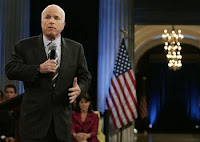 Republican presidential candidate US Senator John McCain (R-AZ) speaks
during a town hall meeting at Federal Hall in New York June 12, 2008.
SPRINGFIELD, Missouri (Reuters) -- Republican John McCain promised on Wednesday to put the United States on course to build 45 new nuclear reactors by 2030 if elected president as part of a plan to move the country toward energy independence.
McCain, his party's presumptive nominee in this fall's presidential election, is laying out a strategy to wean the United States from foreign oil, an issue that has risen to the top of voters' minds as gasoline prices soar.
The Arizona senator has argued forcefully for more nuclear plants, seeing them as part of a solution to fighting climate change and establishing U.S. energy independence.
There are 104 operating U.S. nuclear reactors at present, which generate about 20 percent of the country's power supply.
"If I am elected president, I will set this nation on a course to building 45 new reactors by the year 2030, with the ultimate goal of 100 new plants to power the homes and factories and cities of America," McCain told a campaign event in Missouri, an electoral battleground state.
"If we're looking for a vast supply of reliable and low-cost electricity -- with zero carbon emissions and long-term price stability -- that's the working definition of nuclear energy."
Illinois Sen. Barack Obama, McCain's presumptive Democratic opponent, has issued supportive statements about nuclear power but has set no outright goal for building plants.
Though nuclear energy is key to meeting U.S. climate concerns, the issue of disposing of nuclear waste from U.S. plants and solving nuclear proliferation concerns are also paramount, Obama's campaign said on its website.
Godfather's son sues over game
 (pcpro.co.uk) -- The son of "The Godfather" author Mario Puzo has sued Paramount, claiming the company had failed to pay royalties from the video game that was based on the book and subsequent movie. Anthony Puzo has filed court documents to the Los Angeles Superior Court claiming at least £500,000 in damages for breach of contract.
Paramount had licensed Electronic Arts in 2006 to produce and distribute a game based on the storyline of the Godfather trilogy. Author Mario Puzo died in 1999, leaving his estate to his children.
"In material breach of the audio-visual products agreement, Paramount has failed and refused to pay the Puzo Estate the sums due it in respect of the Godfather game," said the court filing.
According to the lawsuit, this agreement was made because Puzo was originally paid "an extremely low price" by Paramount for the film rights to his book as at the time he was a "young, relatively unknown author, struggling to support his family."
Puzo's book about the Corleone Mafia family was adapted into one of the most successful award-winning movies of all-time, starring Marlon Brando and Al Pacino
Firefox 3 browser is nifty and packed with handy features

(usatoday) -- Even if you're an active Web surfer you probably don't pay much attention to the browser you are using. By default, you likely employ Microsoft's Internet Explorer on a Windows machine, if only because Internet Explorer sits right there on your desktop. The Apple crowd typically sticks with Safari.
Still, many of us in recent years have been drawn to a feature-rich browser called Firefox from the non-profit Mozilla organization. This week Mozilla released a speedy and more secure new version called Firefox 3.
I've generally had a very good experience testing Firefox 3 on Windows PCs and Macs. (It also works on Linux.) It's snappier than Internet Explorer and uses less memory. I had no trouble migrating from Firefox 2. And Mozilla claims Firefox 3 has more than 15,000 improvements, though I'll have to take their word for it because most of the action is under the hood.
Why go to the trouble of switching browsers? Through the years, Microsoft has been slow to innovate. Guess that comes with owning a monopoly share. It was late to the party with such features as tabbed browsing, which lets you keep multiple browser windows open at the same time. (The feature is there now.)
And for a while anyway, Internet Explorer seemed to have more gaping holes than Swiss cheese, though to be fair it's gotten a lot more secure in recent iterations. Still, the door was left wide open for more nimble rivals, including Apple's Safari (which now also works on Windows), Norway's Opera and, of course, Firefox.
I've long appreciated the "restore previous session" feature in Firefox, which opens the tabs and windows from your previous session should the browser unexpectedly crash — neither Internet Explorer nor Safari has that feature. A Firefox pop-up blocker arrived early on. A built-in spell-checker is another core feature.
As "open source" software — meaning the code is open to all programmers — Firefox is also extremely customizable. Some 5,000 add-on programs have been made available, though not all of them are ready for version 3. I was unable to load Google Send to Phone for Firefox because as a pop-up window warned, "It does not provide secure updates." Mozilla said about 75% of the most-used add-ons were compatible with Firefox 3 in the days leading up to the launch; most of your favorites should catch up quickly.
Firefox 3 is less of a hog on system resources than its predecessor or Internet Explorer. I opened a dozen popular sites in Firefox on a Vista machine and opened the same ones with Microsoft's browser. Firefox used a lot less memory.
Let's take a closer look at the latest version of the Mozilla browser.
•Easy navigation. Arguably the most useful new feature is the "Smart Location Bar," aka, the "Awesome Bar." Start typing and Firefox serves up a drop-down list of possible cyberdestinations based on sites you've already visited, bookmarked or tagged. It learns as you go. The words you type appear in bold, making it a cinch to find an appropriate match if there is one. Typing "Ru" brought up listings of sites I visited after Tim Russert died.
Firefox makes intelligent (and usually correct) guesses when you enter text. You won't always have to type in a complete Web address. When I typed "Mets" and pressed enter, I was transported to the official site of my favorite ball club. When I typed "onion," I was taken to the Onion humor site. On Internet Explorer, typing "Mets" and "onion" took me to search pages instead.
Bookmarking is also a breeze. A star icon appears to the right of the Web address in the location bar. Click the star once to save the location as a bookmark. Or double-click the star to tag and save the site to a particular location.
And you can click on a new Most Visited folder to check out the sites you hang out at most often, one of the available "smart bookmark folders."
•Security. You were warned in Firefox 2, and for that matter Internet Explorer, when coming upon a "phishing" site. These bogus sites try ripping you off by masquerading as real financial (or other) institutions. With Firefox 3, Mozilla broadens the alarm to include sites that attempt to attack your machine with viruses, spyware or other "malware." A pop-up appears with a "get me out of here" button; you can also click for an explanation of why the site is blocked.
Clicking on a tiny icon to the left of the location bar lets you determine if a site you are visiting is legit.
Mozilla's rivals aren't standing still. Opera just released its own new version with features that keep bookmarks and notes synchronized between the desktop browser and one on your cellphone. Microsoft is readying a new version of Internet Explorer, and the bet is Apple is doing the same with Safari. And the Flock "social browser" (which is built on top of Firefox technology) is in trials with a new test version of its own. The way it's going, you may even start paying more attention to the browser that you are using.
Scientists discover way to color MRI scans
 A radiologist studies an image from a magnetic resonance imaging (MRI) scanner
at the Ambroise Pare hospital in Marseille, southern France, April 8, 2008.
CHICAGO (Reuters) -- U.S. scientists have developed a way to add color to medical scans known as MRIs, potentially enhancing the information and sensitivity the images provide, they said on Wednesday.
MRI stands for magnetic resonance imaging. The technique uses a magnetic field and radio waves to get cross-sectional images of organs and structures the inside the body. Chemical contrast agents help enhance the quality of the images, but they are typically only in shades of gray.
"Once you put things in different colors, you can get a lot of different information out than you can in black and white," said Gary Zabow of the National Institute of Standards and Technology, whose research appears in the journal Nature.
"You might imagine having a normal cell in blue and a cancer cell in red. You can track those cells in the body and see how they behave," Zabow said in a telephone interview.
Instead of using conventional chemical contrast agents to improve MRI image quality, Zabow and colleagues fabricated tiny magnets that could be made using the same methods used by silicon chip makers to develop advanced computer chips.
By adjusting the physical shape of the magnets, they can adjust the radio-frequency signals that make up the image. The radio-frequency signals could be converted into a rainbow of colors by a computer.
"We are able to engineer whatever color we want to by changing the exact geometry of the particles we make," Zabow said.
Each micromagnet consists of two round discs stacked on top of each other with a gap in the middle. As water flows between the discs, protons within the water's hydrogen atoms generate radio-frequency
Zabow thinks the design of the magnets may make them easier to customize than conventional injectable MRI contrast agents, which are made through a chemical synthesis process.
Zabow and colleagues at NIST and the National Institutes of Health fashioned their micromagnets out of nickel, a substance that is toxic to humans. But Zabow said they could just as easily be made out of iron or other magnetic materials. "That is essentially nontoxic," he said.
Zabow said the finding is very early and a long way from testing in humans. "What we are doing here is demonstrating a new idea," he said. Read More......
Astronomers find batch of "super-Earths"
 An artist's impression of the trio of super-Earths discovered by an European team using the HARPS spectrograph on ESO's 3.6-m telescope at La Silla, Chile, after five years of monitoring.
WASHINGTON (Reuters) -- European researchers said on Monday they discovered a batch of three "super-Earths" orbiting a nearby star, and two other solar systems with small planets as well.
They said their findings, presented at a conference in France, suggest that Earth-like planets may be very common.
"Does every single star harbor planets and, if yes, how many?" asked Michel Mayor of Switzerland's Geneva Observatory. "We may not yet know the answer but we are making huge progress towards it," Mayor said in a statement.
The trio of planets orbit a star slightly less massive than our Sun, 42 light-years away towards the southern Doradus and Pictor constellations. A light-year is the distance light can travel in one year at a speed of 186,000 miles a second, or about 6 trillion miles.
The planets are bigger than Earth -- one is 4.2 times the mass, one is 6.7 times and the third is 9.4 times.
They orbit their star at extremely rapid speeds -- one whizzing around in just four days, compared with Earth's 365 days, one taking 10 days and the slowest taking 20 days.
Mayor and colleagues used the High Accuracy Radial velocity Planet Searcher or HARPS, a telescope at La Silla observatory in Chile, to find the planets.
More than 270 so-called exoplanets have been found. Most are giants, resembling Jupiter or Saturn. Smaller planets closer to the size of Earth are far more difficult to spot.
None can be imaged directly at such distances but can be spotted indirectly using radio waves or, in the case of HARPS, spectrographic measurements. As a planet orbits, it makes the star wobble very slightly and this can be measured.
"With the advent of much more precise instruments such as the HARPS spectrograph ... we can now discover smaller planets, with masses between 2 and 10 times the Earth's mass," said Stephane Udry, who also worked on the study.
The team also said they found a planet 7.5 times the mass of Earth orbiting the star HD 181433 in 9.5 days. This star also has a Jupiter-like planet that orbits every three years.
Another solar system has a planet 22 times the mass of Earth, orbiting every four days, and a Saturn-like planet with a 3-year period.
"Clearly these planets are only the tip of the iceberg," said Mayor.
"The analysis of all the stars studied with HARPS shows that about one third of all solar-like stars have either super-Earth or Neptune-like planets with orbital periods shorter than 50 days."
Study shows coffee reduces heart disease risk
 Researchers have said coffee drinkers have less chance of contracting heart disease
than non-drinkers. Image: Love coffee. Credit: Ahmed Rabea/flickr
(thetechherald) -- European researchers have shown coffee drinkers to be less at risk of heart disease than people who do not drink the beverage.
A study of 129,000 men and women over two decades showed regular coffee drinkers were less at risk of heart attacks, stroke, and arrhythmia. Women who drank four to five cups per day 34% less likely to die of heart disease, while men who drank the same amount 44% less likely to die from the same cause.
Experts believe that coffee may combat the illness by reducing damage caused at the early stage of heart disease.
"It looks like coffee has some effect that hasn't been established before. The general idea is that coffee is not so bad," says study leader Esther Lopez-Garcia, an epidemiologist at the Autonomous University of Madrid to the New Scientist.
However researchers stopped short of recommending coffee as a health drink saying more research needed to be done on the subject before such a claim could be made.
Some other studies though have found coffee drinkers to have less likelihood in contracting liver cancer and diabetes. Read More......
18 June 2008
Statistics show Firefox 3 spreading fast
 Firefox 3 gained market share rapidly, even before it was 24 hours old.
 (Credit: NetApplications)
(CNET) -- Firefox 3 is spreading fast, claiming more than 4 percent of the share of Web browser usage less than 24 hours after its release.
According to Net Applications, which monitors browser usage at major Web sites, Firefox 3 rapidly ascended to what I'd call force-to-be-reckoned-with status, something Web designers shouldn't be ignoring. For comparison, Apple's Safari had 6.25 percent share in May, and Opera had 0.71 percent.
Undoubtedly, most Firefox 3 activity is from existing Firefox users, but it's still a notable achievement, given that software companies constantly struggle to get users to adopt the latest products.
Mozilla, which sponsors and oversees development of the open-source Web browser, released Firefox 3 for download on Tuesday. It primed the publicity pump with an effort to set a 24-hour download record, and interest by the abundant Firefox loyalists brought Mozilla's servers to their knees for nearly two hours Wednesday.
Mozilla has been fulfilling pent-up demand ever since. Sometime after 7 a.m. PDT, downloads crossed the 7 million mark, according to Mozilla's download counter, which is fun to watch, even though it's badly formatted.
The download rate, which peaked at 14,000 per minute Tuesday, was about 6,600 per minute Wednesday morning.
For full coverage, including reviews and videos, see CNET's Firefox 3 resource center. Read More......
Toshiba: new laptop -- world's lightest
 Toshiba headquarters building stands against the backdrop of the sky in Tokyo July 31, 2006. (Xinhua/Reuters, File Photo)
BEIJING, June 18 (Xinhuanet) -- Toshiba Corp. claimed that the newly-launched ultraportable laptop, the Portege R500-S5007V, is the world's lightest, according to U.S. media reports Wednesday.
The claim came after the Tokyo-headquartered electronics manufacturer announced it added a 128GB solid state drive (SSD) to its straw-weight laptop.
The Portege R500 now measures 0.77 inches (about 1.96 cm) at its thinnest point and weighs at just 2.4 pounds (1.08 kg), compared to Apple's MacBook Air, 3 pounds (about 1.36 kg), and Lenovo's Thinkpad X300, around 2.93 pounds (about 1.33kg).
The new laptop is outfitted with a 7mm DVD SuperMulti Drive to go with the new SSD, which consumes less power as it has no moving parts like a hard drive and gives the battery more runtime. According to the company, the laptop can run for eight hours on a single battery charge.
The notebook also features a 1.33GHz Intel Core 2 Duo chip and a transreflective backlit LED screen.
Porteges with the SSD will cost 2,995 U.S dollars, roughly 1,000 dollars more than the versions with hard disks in the 120GB to 160GB range.
The laptop will start shipping in the third quarter this year, according to the company. But it wasn't available to comment on worldwide availability. Read More......
Student's life as a hacker exposed by eBay tip-off
 T Bharathwaj Purohit (TOI Photo)
CHENNAI (timesofindia.indiatimes) -- Police on Tuesday arrested a college student for purchasing electronic goods online using credit card details of card holders from across the world.
T Bharathwaj Purohit (20), a resident of MKB Nagar and a member of a community of hackers, had been buying electronic goods online using other people’s credit cards since April. Police recovered an electric guitar, a printer, an LCD TV, a digital camera, a weighing scale, a mobile and a laptop all worth Rs three lakh, and Rs 38,500 in cash from him.
Purohit met Charu Sharma of Mumbai and Hathi Gogaiyan of Ahmedabad online a few months ago. They introduced him to an online hackers’ community on the net and gave him credit card details to make purchases.
“Following Sharma and Gogaiyan’s advice, Purohit tried to book an expensive mobile and i-pod using the data they provided. To his surprise, he received the items within a week. He also couriered the valuables to them as gifts. He started buying more goods online on ‘eBay’, an online auction website,” deputy commissioner of police B Vijayakumari said.
Sharma and Gogaiyan had given Purohit details of US credit card holders. Following complaints from an eBay investigation officer, the city police arrested Purohit. He had made his purchases from his personal computer. The police, with the help of the cyber crime wing, tracked down his IP address. Preliminary inquires revealed that this group of hackers got bank accounts and credit card details of people for a price.
“We have received information that the Mumbai police cornered Sharma and Gogaiyan a few days ago for another credit card cheating case in Mumbai. We have taken Purohit into custody to get more details,” a senior police officer said.
Police booked Purohit under several sections of the IPC, including 420 (cheating). He was remanded in judicial custody after being produced before the magistrate court on Tuesday.
NVIDIA unleash GeForce GTX 200 GPUs
 NVIDIA's new family of graphics processors
(gizmag) -- NVIDIA’s new family of GeForce GTX 200 graphics processors (GPUs) - which includes the GeForce GTX 280 and GeForce GTX 260 GPUs - include NVIDIA CUDA technology and the new CUDA runtime for Windows Vista, which allows programmers to offload the most intensive processing tasks from the CPU to the NVIDIA GPUs. The GPUs also deliver 50% more gaming performance over the Company’s previous NVIDIA GeForce 8800 Ultra GPU with impressive shading horsepower at resolutions as high as 2560 x 1600.
Rendering 3D images in real-time is just about the most mathematically intensive task a PC will ever undertake, but as PC applications become increasingly visual, many ordinary tasks will benefit from the graphics horsepower provided by the GPU, including editing photos, simply running a new operating system such as Windows Vista or encoding and playing high-definition videos. Recognizing this the new cards feature NVIDIA’s PureVideo HD Technology, which delivers a combination of HD video decode acceleration and post-processing for unprecedented picture clarity, smooth video, accurate color, and precise image scaling for movies and video. The GPUs also take advantage of massively parallel, general-purpose computing architecture to transcode high-quality video 18 times faster than with CPU-only implementations.
An increasing number of applications are also being written that use the GPU for straight, non-graphical computational tasks. Stanford B-School-Isnt-What-It-Used-To-Be University’s distributed computing computational program Folding@Home, combines the computing horsepower of millions of consumer GPUs to simulate protein folding to help find cures for diseases such as Alzheimer’s or Parkinson http://en.wikipedia.org/wiki/Parkinson ’s. With the computing processing power of the GeForce GTX family, applications such as Folding@Home and others can run upwards of 140 times faster on an NVIDIA general-purpose parallel processor than on some of today’s traditional CPUs.
But gamers need not fear NVIDIA is ignoring its gaming roots. NVIDIA believes the CUDA general-purpose parallel processing mode will usher in a new generation of ultra realistic games by using the power of the “CUDA Computing” mode to simulate realistic, physically accurate effects then render images using the “GeForce GPU” mode. NVIDIA GPUs are also the only ones to support PhysX technology, the world’s most pervasive physics engine that allows developers to incorporate effects such as rigid body dynamics, collision detection, and cloth simulation. The cards’ 3-way NVIDIA SLI Technology also offers impressive performance scaling by implementing 3-way alternate frame rendering (AFR) to provide what it claims is the world’s fastest gaming solution under Windows Vista.
Graphics cards featuring GeForce GTX 280 GPUs are available now while Graphics cards featuring GeForce GTX 260 GPUs will be available starting on Thursday, June 26, 2008. Suggested retail pricing for the GeForce GTX 280 and GeForce GTX 260 GPUs are USS$649 and $399, respectively. For further info visit NVIDIA.
AMD's new Firestream chip tops 1 teraflop
 (reghardware) -- The latest round of graphics card dueling between AMD and Nvidia isn't just over high-end gamers. The vendors will also exchange blows for the hearts and wallets of your friendly neighborhood medical imagers, seismic modelers, and computational fluid dynamisists.
AMD is refreshing the FireStream processor line with a new general purpose GPU (GPGPU) that boasts more than one teraflop of processing power.
Instead of handling gaming or graphics operatins, GPGPUs are built to crunch hundreds of parallel calculations per clock cycle. They promise massive speed improvements over a CPU in mathematical workloads of the scientific, educational and high performance computing variety.
AMD claims developers are reporting up to a 55x performance increase on financial analysis codes as compared to using a CPU alone.
AMD's new card succeeds the FireStream 9170, released last November and capable of 500 gigaflops for single precision performance. The FireStream 9250 is capable of 1 teraflop for single precision calculations, or 1 trillion floating-point operations per second.
Nvidia is similarly rolling out its 240-core Tesla-10 Series GPGPU chip that's also capable of 1 Teraflop of computational muscle.
Pirates Hitting Wii Accessories and Wii Motes

(mywii.com.au) -- Pirated WiiMotes and Nunchuks for the WiiMote have finally hit the market within Japan. The boxes that contain the false items are made to look identical in all form but to tell the real from the fake you would need a real one and fake one side by side and then you would realise which one is fake and real. The WiiMotes even come with a fake Club Nintendo pin number

Could these pirated WiiMotes soon hit Australian shores and be sold for a dollar or more at your local market?
More Pics Here
translate.google.com/
and Here
translate.google.com/ Read More......
Trainers Using Wii Fit To Rehab Injured Athletes
 (redorbit) -- Nintendo’s Wii Fit is finding its way into rehabilitation programs for injured athletes.
Sue Stanley-Green, a professor of athletic training at Florida Southern College in Lakeland, said Wii Fit and other fitness-oriented video games have "great potential" for core strengthening and rehabilitation and may boost compliance with rehabilitation exercises.
"We are looking to incorporate Wii Fit into the athletic training room as far as rehabilitation, for example, on post-operative knees and ankles," she said.
Rehab centers can benefit from fitness video games that focus on upper body movement patterns. For instance, tennis video games can be used to safely exercise the rotator cuff after injury or repair.
Stanley-Green said fitness-oriented video games are also being used more and more in nursing homes for rehabilitation, providing a fun way to help elderly people expand their range of motion.
Getting patients to perform tedious, repetitive exercises can be one of the most difficult aspects of rehabilitation
. The entertainment value inherent in video games may help boost compliance with rehabilitation and perhaps improve outcomes.
"Fitness video games have some really good potential to improve fitness in everyone," Stanley-Green said.
"My daughter is 12 and she has a friend who is very inactive and overweight and has some body control issues and the Wii Fit has really been a good thing for her," she explained. "This is a child who would rather eat than anything and it's the first time I have ever seen her say, 'I'm not coming to dinner, I'm playing the Wii.'"
Stanley-Green believes anyone can play these games.
"I am illiterate as far as video games but these are games that anyone can have success with. My daughter absolutely hates the fact that I am better at this one balance game than she is," she said.
However, like any physical activity, too much repetition of one type of movement may not be healthy.
"There are some documented cases of 'video-game shoulder' and 'video-game elbow', so using the proper form and technique should be stressed," Stanley-Green noted.
"Of course, ideally use of the gaming consoles should be alternated with other physical activities."
Wii-like phone unveiled
 Sony Ericsson F305
(AFP/iafrica) -- Sony Ericsson, the Swedish-Japanese phone maker, on Tuesday unveiled a Wii-like handset which allows users to play games using the phone as a motion sensor.
"This is our first foray into motion gaming," Howard Lewis, vice president and head of the product business unit, said of the F305 mobile phone launch held in conjunction with CommunicAsia, an industry convention and exhibition.
"We see gaming as a way to interact with our young customers ... it's a new area of the market that Sony Ericsson is entering into," he said.
With the F305 phone, the device itself acts as a motion sensor when playing pre-loaded games including bowling and bass fishing, the company said.
Japanese videogame giant Nintendo Co.'s wildly popular Wii console is known for its innovative motion-sensitive controller.
Beijing 2008 Olympic Games100M Gameplay From SEGA
SEGA releases a 100M event gameplay footage from Beijing 2008 Olympic Games. Coming to PS3, Xbox 360 and PCs.
Firefox 3.0 Released, Servers Overwhelmed

(pcworld/macworld) -- Mozilla has released Firefox 3.0, the final release of the newest version of its popular Web browser. The company may have been a bit unprepared for the onslaught of Web traffic the release generated; reports note that its servers have been overwhelmed since the release.
Mozilla released Firefox on Tuesday after a public preview that lasted months, through myriad alpha and beta development builds and several release candidates.
New features in Firefox 3.0 include one-click bookmarking, instant Web site ID (to help identify online scams and unsafe transactions), improved performance, Web page zooming, password management, a smart location bar, and platform-native look and feel.
Mozilla hopes to set a world record for downloads with Firefox 3 on Tuesday. Though the big "Download Day" was set to begin at 1 p.m. ET, Mozilla's Web site was down or working sporadically all morning on the East Coast, and users still could not download Firefox 3 from the site more than an hour later.
A Firefox spokeswoman said via e-mail just after 2 p.m. that the company was aware of the problem and "working to get it back up quickly."
Mozilla also outlined the problems it was having with its Web site in a blog entry.
"The outpouring of interest and enthusiasm around Firefox 3 has been overwhelming (literally!)," according to the post. "Our servers are currently feeling the burn and should be back to normal shortly."
Mozilla will begin registering downloads for the record for 24 hours from the moment the site goes live, according to the post.
System requirements call for Mac OS X v10.4 or later, G3 or better (including Intel), 128MB RAM, 200MB hard disk space.
12 June 2008
Opera 9.5 browser released
 (webuser) -- Opera Software has made the final public release of its new browser, Opera 9.5, available for download.
One of the key features in version 9.5 is Opera Link, which will synchronise the browser across several different devices such as mobile phones, desktops, PDAs and even Wii games consoles, keeping your bookmarks and other settings up-to-date.
Opera first started testing the latest build nine months ago and the release comes just days before Mozilla releases the full version of its Firefox 3 browser.
Another feature new to Opera 9.5 is Quick Find, designed to help surfers locate pages in their history just by typing a key word into their address bar. Firefox has a similar feature called the "Awesome Bar" built into its latest browser release.
Security against malware and phishing has also been strengthened in Opera 9.5.
"Opera's Fraud Protection not only protects you from fraudulent websites, it is now the first browser publically available to protect you from malware and other malicious software on the web, " the company said.
Versions of Opera 9.5 are available for download from the Opera homepage for Mac, Linux and Windows platforms, in 30 different languages.
www.opera.com
Wii Fit underwear girlfriend spoofed online
 The "Wii Fit Girlfriend", the video clip of an attractive girl wiggling her bottom playing the motion-sensor video game, has drawn the inevitable attention of the internet's army of parodists.
(telegraph) -- The most famous spoof is a straightforward battle-of-the-sexes reversal – a salacious-looking woman leers at the camera before turning it to her boyfriend, clad in dingy yellow Y-fronts, who gyrates as he tries to guide his on-screen avatar down a ski slope.
The clip, entitled "Why every girl should buy their boyfriend Wii Fit", ends – as does the original – with the camera-operator sticking her tongue out lewdly.
Another version seems to have been made to undermine the sexy nature of the first clip. "Wii Fit Hula Hoop makes you look stupid", as it is uncompromisingly called, shows a woman in her pyjamas swinging her hips in a manner reminiscent of a young Shakin' Stevens.
Exasperated viewers have left a series of comments below the clip informing the hapless hula girl that "she's doing it wrong".
The original clip, in which 25-year-old Lauren Bernat is secretly filmed by her boyfriend Giovanny Gutierrez as she attempts a hula game, has been seen over two million times.
Rumours have since flooded the web that it is a clever piece of viral advertising by the game's creators Nintendo – a theory that gained ground after it emerged that both Miss Bernat and Mr Gutierrez work in advertising.
However, the couple strenuously deny any such intention, and a spokesman for Nintendo also rejected the accusation.
"This has and is absolutely 100 per cent nothing to do with Nintendo," he said.
"Nintendo did not create it and were not aware of it until it was brought it to our attention."
Lawmakers: Capitol computers hacked by Chinese
 WASHINGTON (AP/bostonherald) -- Multiple congressional computers have been hacked by people working from inside China, lawmakers said today, suggesting the Chinese were seeking lists of dissidents.
Two congressmen, both longtime critics of Beijing’s record on human rights, said the compromised computers contained information about political dissidents from around the world. One of the lawmakers said he’d been discouraged from disclosing the computer attacks by other U.S. officials.
Virginia Rep. Frank Wolf said four of his computers were compromised, beginning in 2006. New Jersey Rep. Chris Smith, a senior Republican on the House Foreign Affairs Committee, said two of his computers were attacked, in December 2006 and March 2007.
Wolf said that following one of the attacks, a car with license plates belonging to Chinese officials went to the home of a dissident in Fairfax County, Va., outside Washington and photographed it.
During the same time period, The House International Relations Committee — now known as the House Foreign Affairs Committee — was targeted at least once by someone working inside China, said committee spokeswoman Lynne Weil.
Wednesday’s disclosures came as U.S. authorities continued to investigate whether Chinese officials secretly copied the contents of a government laptop computer during a visit to China by Commerce Secretary Carlos M. Gutierrez and used the information to try to hack into Commerce Department computers.
The Pentagon last month acknowledged at a closed House Intelligence committee meeting that its vast computer network is scanned or attacked by outsiders more than 300 million times each day.
Wolf said the FBI had told him that computers of other House members and at least one House committee had been accessed by sources working from inside China. The Virginia Republican suggested that Senate computers could have been attacked as well.
He said the hacking of computers in his Capitol Hill office began in August 2006, that he had known about it for a long time and that he had been discouraged from disclosing it by people in the U.S. government he refused to identify.
"The problem has been that no one wants to talk about this issue," he said. "Every time I’ve started to do something I’ve been told ’You can’t do this.’ A lot of people have made it very, very difficult."
The FBI and the White House declined to comment.
The Bush administration has been increasingly reluctant publicly to discuss or acknowledge cyber attacks, especially ones traced to China.
In the Senate, the office of Sen. Dick Durbin, D-Ill., who chairs the Senate’s subcommittee on humanitarian issues, asked the sergeant at arms to investigate whether Senate computers have been compromised.
Wolf said the first computer hacked in his office belonged to the staffer who works on human rights cases and that others included the machines of Wolf’s chief of staff and legislative director.
"They knew which ones to get," said Dan Scandling, who currently is on leave of absence from his job as Wolf’s chief of staff. "It was a very sophisticated operation," he said. "The FBI verified that it had been done."
Smith said the attacks on his office computers were "very much an orchestrated effort."
He said that after the first intrusion in December 2006, "that was the last time" his office put the names of dissidents on its computers.
In Beijing, the Chinese Ministry of Foreign Affairs had no immediate comment on the allegations by Wolf and Smith.
Last week, China denied the accusations regarding Gutierrez’s laptop and the alleged effort to hack Commerce Department computers.
Wolf said he was introducing a House resolution that would help ensure protection for all House computers and information systems.
It calls for the chief administrative officer and sergeant at arms of the House, in consultation with the FBI, to alert members and their staffs to the danger of electronic attacks. Wolf also wants lawmakers to be fully briefed on ways to safeguard official records from electronic security breaches.
"My own suspicion is I was targeted by China because of my long history of speaking out about China’s abysmal human rights record," Wolf said in a draft of remarks he prepared to give on the House floor.
He said Congress should hold hearings, specifically the House Intelligence Committee, Armed Services Committee and Government Operations Committee.
Speaking generally in May 2006, Wolf called Chinese spying efforts "frightening" and said it was no secret that the United States is a principal target of Chinese intelligence services.
Wolf thinks that President Bush should stay away from the Olympics because of China’s human rights record.
He also has been outspoken on the subject of violence in the Darfur region of Sudan, where China has major oil interests.
Smith has introduced the Global Online Freedom Act which would prohibit U.S. Internet companies from cooperating with countries such as China that restrict information about human rights and democracy on the Internet.
Wolf and Smith both traveled to Beijing 17 years ago seeking the release of 77 people imprisoned or under house arrest because of their religious activities.
Suicide recruits dropping in Iraq
 Iraqi Army soldiers search a car at a newly-opened checkpoint
into the Shiite stronghold of Sadr City in Baghdad, Iraq
(washtimes) -- The United States is seeing a sharp drop in the number of foreigners entering Iraq to become al Qaeda suicide bombers, according to intelligence and Bush administration sources.
An administration official and a military adviser to Iraqi commanders attribute the decline to a fairly new phenomenon: Al Qaeda's call for mass killings in the name of Islam is losing some of its appeal with young Arabs in North Africa and Saudi Arabia, where most of the bombers originate.
The decline also parallels the battlefield losses al Qaeda has suffered in the past 12 months in Iraq's Anbar province and the greater Baghdad region. This has made it more difficult for al Qaeda in Iraq to facilitate the secret movement of foreigners from the Syrian border to safe houses where they are trained and assigned a target.
"There has been a sharp decline in the amount of suicide bombers coming into Iraq," said a senior intelligence official who spoke on the condition of anonymity. "It's harder for suicide bombers to get into the country. The al Qaeda in Iraq is a shadow of what it once was. And Iraq is a more hostile area for suicide bombers to operate."
The senior official said al Qaeda suicide attacks averaged 50 per month last year, but are as low as 20 a month now.
"They are still cause for concern," the official said.
According to the latest Pentagon report on stability in Iraq, the number of all attacks in Iraq dropped from 1,500 a week in February 2007 to 450 a week in February 2008.
Last year, U.S. military officials say, Sunni Arab Iraqis in large numbers began rejecting al Qaeda's harsh ways and started aiding allied troops in ridding terrorists from their neighborhoods.
A Bush administration official who monitors Iraq confirmed the sharp decline. This official depicted it as a long-running trend that began last year and continues today, rather than just brief dip. "There is no question there are fewer suicide bombers inside Iraq," the official said.
A military intelligence officer previously has told The Washington Times that interrogations of captured foreign fighters showed that most bombers came from Saudi Arabia and North Africa.
'Unicorn' deer with rare single horn spotted in Italy
 This undated photo provided by the Center of Natural Sciences in Prato, Italy, Wednesday, June 11, 2008, shows a deer with a single horn in the center of its head. (AP / Center of Natural Sciences)
ROME (AP/ctv.ca) -- A deer with a single horn in the centre of its head -- much like the fabled, mythical unicorn -- has been spotted in a nature preserve in Italy.
The one-year-old Roe Deer -- nicknamed `Unicorn' -- was born in captivity in a park in the Tuscan town of Prato, near Florence.
He is believed to have been born with a genetic flaw; his twin has two horns.
Calling it the first time he has seen such a case, an official at Prato's Centre of Natural Sciences said today such anomalies among deer may have inspired the myth of the unicorn.
The unicorn, a horse-like creature with magical healing powers, has appeared in legends and stories throughout history, from ancient and medieval texts to the adventures of Harry Potter.
Experts say single-horned deer are rare but not unheard of - but even more unusual is the central positioning of the horn.